Master, teacher at the evangelical school in Jelenia Góra. Chronicler of Jelenia Góra and the list of laws known as the Weichbild of Jelenia Góra
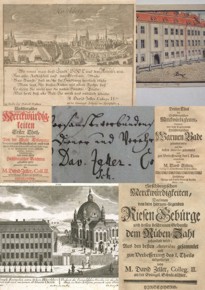
M. David Zeller was born on May 31, 1676, in Ober-Oderwitz near Zittau (Żytawa). The first mentions of Zeller’s ancestors in the source records of Ober-Oderwitz date back to the year 1590. The founder of the family was a householder (cottage worker) Christoph Zeidler (also recorded as Zeller or Zöllner). There is a record of his son Michael, a peasant (farmer) in Ober-Oderwitz. Michael’s son, Christoff Zeller, was a cloth merchant and in the beginning lived in Ober-Oderwitz, but later became a citizen and merchant in Zittau.
This Christoff Zeller was the father of M. David Zeller. His mother was Marie, née Netschin. The parish register in Ober-Oderwitz records David’s baptism on June 1, 1676. The family’s social advancement, from householders (cottage workers) to tradespeople, along with father’s industriousness, enabled David first to have a private education at home and then to attend middle school in Zittau for 11 years. From 1697, David Zeller studied at university in Leipzig, but later in that same year, he transferred to the newly established university in Halle. In 1698, he defeated his academic thesis, and in 1699, he returned to Leipzig, where in 1700, he earned the title of Master of Arts.
The death of Zeller’s parents caused him to return to his family home. For four years, he worked as a home teacher for the sons of M. Kießling in Zittau. From 1707, for more than two years, he worked in the same role for Gottlob Ferdinand von Uechteritz. Thanks to rector Hoffmann, he became a home teacher for the distinguished Glafey family in Hirschberg.
On January 25, 1710, David Zeller was appointed as a teacher at the newly established Evangelical Middle School at the Church of Grace in Hirschberg. That same year, on October 19, he married Sophia Maria Neunhertz, the daughter of Johann Neunhertz—the first pastor (Primarius) of the Church of Grace. According to the church parish registers of Jelenia Góra, they had seven children. An interesting fact is that the godparents of all these children were members of Hirschberg’s most prominent merchant families: the Glafey, the Buchs, and the Mentzel.
The children of David Zeller and Sophia Maria Neunhertz (All born in Jelenia Góra):
- Johanna Sophia, born 1713
- Christian David, born 1715
- Sabina Theodora, born 1716
- Johann David, born 1718
- David Gottfried, born 1721
- Gottlob David, born 1723
- Benjamin David, born 1725
One of the sons, Johann David (born May 27, 1718), served as pastor in Seidorf (Sosnówka) from November 14, 1745, until his death on October 2, 1789.
In volume 5 of Zeller’s Chronicle of the History of Jelenia Góra, about the activities of city doctors in Hirschberg, there is an entry noting that Zeller’s daughter, Miss Johanna Sophia, on April 15, 1733, married Gottfried Ullbrich—a merchant from Jelenia Góra. For him, it was a second marriage.
It is noteworthy that David Zeller and his friend, George Weinnman, received at their disposal two student rooms in the Glafey house. The distinguished and well-known merchant, Gottfried Glafey, who was also a chairman of both the Church Council and the evangelical school, on January 28, 1710, gave two rooms in the so-called Glafey House (Bleichhaus) for educational purposes, which teachers used as lecture halls. These rooms were essential, as within just half a year the number of students in both classes grew to 123. The house was located by the Castle Gate (Burgtor), outside the city walls. From 1928, it housed the Hirschberg City Archive, and from August 14, 1945 until 2004—the State Archive in Wrocław, Jelenia Góra Branch. This building was constructed in the last quarter of the 17th century, and it was painted dark yellow. It stood out for its massive cubature; it came from the time of Hirschberg’s great era of mercantile prosperity. It can be concluded that Zeller wrote his chronicle or conducted related research there (he refers to this fact in volume 11 of his Chronicle, which discusses the establishment of the evangelical school in Hirschberg).
Zeller noted down the names and surnames of all students in the chronicle. Most of them came from Hirschberg, but also from the surrounding areas. According to Kurt Tautz’s work “Die preussische Staatsbibliothek in Hirschberg im Riesengebirge 1944-1945,” it is known that after finishing his work each evening, Zeller requested permission to enter the city through the Castle Gate, then, he left the city by the Wojanów Gate, and returned to his own home, which was near the Church of Grace.
From 1733, David Zeller was a member of the Merchant Association in Hirschberg. He passed away in Hirschberg on September 19, 1738, and was buried in the local cemetery at the Church of Grace.
The Chronicle of the History of Jelenia Góra
M David Zeller left a chronicle of the history of Jelenia Góra and a list of laws known as the Weichbild of Jelenia Góra. The handwritten chronicle consists of 12 volumes and is kept in the State Archive in Jelenia Góra.
• The titles of the individual books:- Von der Stadt Hirschberg Erbauung, Benennung, Situation, Beschaffenheit und Gegend (About the development of the town and its surroundings, naming, location, employment). Municipal Records of Jelenia Góra: Ref. No. 2886.
- Von den Hirschbergischen Ober=Regenten (About the rulers of Jelenia Góra). Municipal Records of Jelenia Góra: Ref. No. 2887.
- Von den Hirschbergischen Bürgermeistern und Raths=Personen (About the mayors of Jelenia Góra and municipality clerks). Municipal Records of Jelenia Góra: Ref. No. 2888.
- Von den Hirschbergischen Parochis, Pastoribus oder Stadt=Pfarren und Schola Rectoribus (About parishes, pastors, city priests, school head teachers). Municipal Records of Jelenia Góra: Ref. No. 2889.
- Von den Hirschberg Stadt=Physicis (About the doctors of Jelenia Góra). Municipal Records of Jelenia Góra: Ref. No. 2890.
- Von den übrigen Hirschbergischen Gelehrten, Geistlichen und weltlichen Standes (About other Jelenia Góra scholars, clergy, and the situation in the world). Municipal Records of Jelenia Góra: Ref. No. 2891.
- Von allerhand Unglücks=Fällen und erlittenen Krieges Drangsalen (About unfortunate accidents and war losses). Municipal Records of Jelenia Góra: Ref. No. 2892.
- Von den Hirschbergischen Weichbilds= Städten, Schmiedeberg, Kupfferberg und Schönau, wie auch von der Herrschafft Arnsdorff (About the neighbouring towns: Kowary, Miedzianka, Świerzawa, and Miłków landed estate). Municipal Records of Jelenia Góra : Ref. No. 2893.
- Von den übrigen Hirschbergischen Weichbilds-Herrschafften als Kynast, Girschdorff, Kemnitz und Dörffern (About other owners of the surrounding estates: Chojnik, Podgórzyn, Stara Kamienica and its villages). Municipal Records of Jelenia Góra: Ref. No. 2894.
- Von der neuen Evangelischen Kirche und ihren ersten Lehrern (About the new evangelical churches and their first teachers). Municipal Records of Jelenia Góra: Ref. No. 2895.
- Von der neuen Evangelischen Schule und einigen andern Begebenheiten (About the new evangelical school and certain events). Municipal Records of Jelenia Góra : Ref. No. 2896.
- Von den Leichen-Schriften in und an den Grüfften und auf den Leichen-Steinen auf unserm Evangel. Gottes-Acker (About gravestones and chapel crypts funereal inscriptions at the cemetery around the Church of Grace). Municipal Records of Jelenia Góra: Ref. No. 2897.
Zeller presumably wrote this chronicle in the final years of his life. For regional researchers, these manuscripts are invaluable and important source material. In them, Zeller lists, for example, the landowners of various locations and chronologically describes their histories up to around 1738. In later volumes, he includes information about Silesian noble families and their activities drawn from the oldest church records. In the books about the history of parishes, teachers, and doctors, Zeller recounts many historical events and interweaves text with quotations from the Bible. The twelfth book contains texts related to the deceased and also inscriptions on epitaphs and chapel crypts at the Church of Grace, which perfectly depicts burgher families’ histories in the early 18th century.
Zeller Printed Works:
- Hirschberger Merckwürdigkeiten – ErsterTheil, Darinnen überhaupt- Von der Stadt Erbauung / Situation und Beschaffenheit / auch was sich sonst bey derselben / biß auf das Jahr 1648, da der Westphälische Friede geschlossen worden, begeben. Verlag Dietrich Krahn, Hirschberg, 1720.
- Hirschberger Merckwürdigkeiten – ZweyterTheil, Darinnen von dem hierum-liegenden Riesen-Gebürge und dessen beschrienen Gespenste dem Rüben-Zahl gehandelt wird ....... Verlag Dietrich Krahn, Hirschberg, 1726.
- Hirschberger Merckwürdigkeiten – ZweyterTheil, Darinnen von dem so genannten Hirschbergischen Warmen-Bade gehandelt wird ....... Verlag Dietrich Krahn, Hirschberg, 1726.
- Kaufmännische Rechen-Schule in sanken und gebrochenen Zahlen, Zittau 1718.
- Einleitung in die Kaufmännische Rechen-Schule, Budißin 1727.
- Vorhof der Schlesischen Rechen-Kunst, Schweidnitz 1736.
- Fortsetzung der Schlesischen Rechen-Kunst, 1737.
Bibliography:
- Johann Karl Herbst, Chronik der Hirschberg in Schlesien bis zum Jahre 1847, p. 455, Hirschberg 1849, Verlag Karl Wilh. Jmmanuel Krahn.
- Moritz Vogt, Jllustrirte Chronik der Stadt Hirschberg i. Schl., pp. 470-475, Hirschberg in Schlesien 1873, Verlag Petzoldt & Pannewitz.
- Maricul der Wollöbl. Kaufmanns-Societät zu Jelenia Góra /Hirschberg/ von ihrer Stiftung 1658 an bis 1818 aus den Acten gezogen, p. 11, Verlag Carl Krahn jun. (Hirschberg) o.J.
- B. E. Hugo Gerstmann, Mitgliederverzeichnis des Schlesischen Gebirgs-Handelsstandes in Hirschberg, Schmiedeberg, Greiffenberg, Landeshut, Jauer, Goldberg, und Waldenburg aus dem Archiv der Kaufmanns-Sozietät in Hirschberg von 1658-1912 und den Schlesischen Instanzien-Notizen von 1802-1827, p. 28, Dresden, 1918
- Johann Heinrich Zedler, Universal-Lexicon aller Wissenschaften und Künste, vol 61, pp. 569-570).
- Die Lebens-Geschichte dieses Schulmanns findet man beschrieben in den Gelehrten Neuigkeiten Schlesiens 1738. p. 357 i d.
Visuals:
- The signature of David Zeller, 1717. Municipal Records of Jelenia Góra. State Archive in Jelenia Góra, Ref. No. 2904, 139.
- Family tree of M. David Zeller
- The Panorama of Jelenia Góra, 1709, copperplate engraving. MJGAH 2659, Karkonosze Museum in Jelenia Góra.
- The Church of Grace and the evangelical school (on the left) in Jelenia Góra, ca.1712, copperplate engraving. MJGAH 2934, Karkonosze Museum in Jelenia Góra.
- D. Zeller, Chronicle Part. 1. Jelenia Góra Digital Library Collections., p. 5.
- D. Zeller, Chronicle Part. 2. Jelenia Góra Digital Library Collections. , p. 127.
- Zeller, Chronicle Part. 3. Jelenia Góra Digital Library Collections., p. 190.
Author - Ullrich Junker
Translation: Natalia Pławiak