Union organizer.

Union organizer NSZZ "Solidarity" , chairman of the union at the tool factory in Jelenia Góra (from September 1980.), founding member of the inter-enterprise founding committee of NSZZ "Solidarity" voivodship of Jelenia Góra, he was active in the opposition after the introduction of martial law.
Parents’ names:
Edmund, Eugenia
Childhood and youth
The family came from Lviv. As a child Kazimierz Majewski was struggling with bone tuberculosis. After World War II, he lived in Łódź with his mother and siblings (3 sisters and brother), and from 1946 they lived in Jelenia Góra.
Adult life
After graduation from primary school, the financial situation forced him to take up work at the age of 14. He began working at the tool factory in Jelenia Góra, also studying and the same time : He completed a number of Journeyman courses and master craftsman course in the milling. At his workplace, he was an active social organizer and an innovator; he founded the Honorary Blood Donors Club and was awarded the Bronze Badge of the Polish Red Cross. At work he was valued by his superiors, colleagues, and students for his professionalism, knowledge, responsibility, discipline, and uncompromising nature.
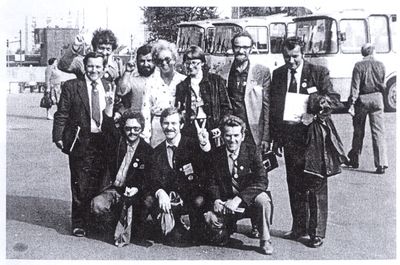
In September 1980, he was elected chairman of the Factory Committee of the Independent Self-Governing Trade Union "Solidarity" at the Tool Factory in Jelenia Góra. He participate in the founding meeting of the Inter-Enterprise Founding Committee of NSZZ "Solidarity" of the Jelenia Góra voivodship on 17 September 1980, which took place at the Provincial Communication Office in Jelenia Góra with participation of representatives from 38 workplaces. He participate in the strike at the "Gencjana" club at the Fampa Paper Machinery Factory in Jelenia Góra from 22 January to 10 February 1981. He was a delegate to the provincial Voivodship Congress of Delegates in May – June 1981, as well as to the First National Congress of Delegates of NSZZ "Solidarity" in Gdańsk in September – October 1981.
After the imposition of martial law in Poland on the night of 12 – 13 December 1981, he was detained along with a group of activists by the Security Service [SB] at the headquarters of the Regional Board, taken to the Municipal Headquarters of the Citizens’ Militia in Jelenia Góra, and released after interrogation.
From very beginning of martial law, he actively participated in the creation of the underground "Sodilarity" structures in Jelenia Góra, engaging in printing activities and distributing illegal publications. He cooperated among others with Tadeusz Lewandowski, Ludwik Blumberg, and Władysław Niegosz. The Security Service carried out an operation against him and other activists under the codename 'Postponement,' concerning the printing of a publication of the same title. Harassed by the Security Service [SB] his health declined, and his cardiovascular and spinal ailments worsened. From January 1982 he was on medical leave for six months and took early retirement on 20 July 1982. He worked occasionally in the private metalworking shop of Stanisław Mendrygała.
On August 1982, Kazimierz Majewski was detained and placed in the internment center in Nysa. At the same time, 25 activists from the Jelenia Góra Voivodeship were held there, including Stanisław Kostka, Zdzisław Bykowski of Lubań, Kazimierz Grzelak and Jan Skowroński of Zgorzelec, Tadeusz Lewandowski and Edward Woskowicz of Jelenia Góra, and Jerzy Orłowski of Piechowice [see: A. Piesiak, Solidarność Jeleniogórska…, p.4]. He was released from Nysa camp on the 29 September 1982, due to health reasons. He continued his underground activities by organizing a branch of the Polish Catholic-Social Union in Jelenia Góra.
In October 1982, the SB increased its harassment of Kazimierz Majewski: surveillance, frequent interrogations, threats of death under unexplained circumstances, attempts to coerce him into collaboration, and threats of harm to his wife and children (son Dariusz, born 1962, and daughter Małgorzata, born 1971), among other tactics. These interrogations – the last of which took place on 26 October 1982 – and especially fear for his loved ones, led to a nervous breakdown. He committed suicide on 28 October 1982, under circumstances that remain unexplained to this day.
He was buried in the parish cemetery in Jelenia Góra – Cieplice. During the martial law period, opposition activists gathered at his gravesite (at the call of Jelenia Góra members of ‘Fighting Solidarity’) to pay tribute in this way to all ‘victims of the communist dictatorship’.