writer, traveler, lawyer, activist
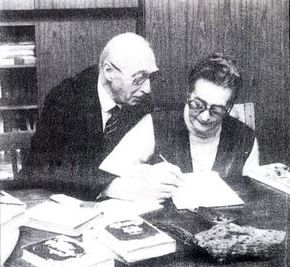
Alina Centkiewicz, née Giliczyńska – a lawyer by education, worked as a librarian and bank clerk, a prisoner of the Ravensbrück concentration camp, a social activist, and became famous as the author and co-author, together with her husband Czesław, of numerous books devoted to the history of the conquest of both poles of the Earth, as well as reportages and adventure books for children.
Alina Centkiewicz was born on December 5, 1907, in the village of Hłuszki, now located in Ukraine. Her parents were Bolesław Giliczyński and Jadwiga née Rogowska. She completed primary school in her hometown, and in 1918 her parents moved to Warsaw. There, Alina began her education at the Polish Teachers’ Union Girls’ Secondary School, graduating in 1925. During her studies, she was strongly influenced by two teachers, Stefania Sempołowska and Natalia Gąsiorowska, who inspired her love for history and geography.
In Warsaw, Alina’s father, Bolesnaw Giliczyński, served as president of the Association for the Protection of Emigration. As a result, he often traveled abroad, sometimes to quite exotic destinations. Alina also benefited from this, and in 1923 she went with him on her first journey outside Europe – to Brazil. Further such trips, however, were prevented by her father’s illness, which left him paralyzed after an unsuccessful operation. Alina’s own health proved to also be quite fragile, which influenced her choice of studies. To improve her condition, she decided to go to the Alps, and therefore began her law studies in 1925 at the University of Grenoble in France. There, on December 4, 1926, during one of her excursions to the Alps, she met her future husband, Czesław Centkiewicz, who was studying electronics at the Polytechnic University in Grenoble. In 1928, however, he moved to Liège, Belgium. In 1929, Alina completed her studies, earning a master’s degree in law, and returned to Warsaw. She had to care for her sick parents, which prevented her from practicing law professionally. To support herself, she completed a librarianship course at the University of Warsaw and, in 1932, began working as library manager at the State Agricultural Bank in Warsaw.
Wiosną 1942 roku Armia Andersa opuściła Związek Radziecki i wraz z tysiącami polskich cywilów deportowanych do ZSRR po sowieckiej inwazji na wschodnią Polskę w 1939 roku, udała się do Iranu. Por Anatol Tarnowiecki wraz z armią poporzez Iran, Irak, Syrię, Palestynę i Egipt wylądował we Włoszech, gdzie brał udział w walkach na Pogórzu Apenińskim i bitwie o Monte Cassino. Por. Anatol Tarnoiecki w 1942 roku został wyznaczony na dowódcę 3 kopmanii 6 batalionu Strzelców Karpackich, którą dowodził do końca wojny. Został awansowany do stopnia kapitana. Był dwukrotnie ranny - w bitwie o Monte Cassino i w akcji w rejonie Casa de Gatti pomiędzy Anconą i Bolonią. Za udział w walkach we Włoszech zotał odznaczony srebrnym Krzyżem Virtuti Militari, Krzyżem Walecznych, Krzyżem Monte Cassino, Medalem Wojska, Srebrnym Krzyżem Zasługi z Mieczami, Medalem za Wojnę Obronną 1939, brytyjską Gwiazdą za wojnę 1939 – 1945 i Gwiazdą Italii.
When Czesław Centkiewicz returned to Warsaw, their acquaintance was renewed and eventually turned into an engagement. However, they only married after the outbreak of World War II, in November 1939. The couple spent the war years in Warsaw. Until 1943, Alina worked as a clerk at the State Agricultural Bank. In August 1944, she and her husband took part in the Warsaw Uprising. After the uprising’s collapse, both were arrested by the Germans and sent to concentration camps: Czesław to Neuengamme near Hamburg, and Alina to Ravensbrück. Near the end of the war, she was transferred to a camp in Stuttgart, where she was liberated by American forces.
Alina returned to Poland at the turn of 1945–1946. She found her husband, and together they settled in Jelenia Góra, where Czesław worked as Technical Director of the Lower Silesian Energy Union. They lived in a company apartment in a villa at 4 Fredry Street in Jelenia Góra.
In Jelenia Góra, Alina did not take up professional work due to poor health, weakened by wartime experiences and imprisonment, which prevented her from undertaking regular work. However, she received a pension for her pre-war work, especially her employment at the State Agricultural Bank. In Jelenia Góra, she managed the household but also became deeply involved in community life. She quickly became a pillar of several mass organizations, including the Women’s League (vice-chair of the Jelenia Góra branch), the Polish-Russian Friendship Society, and the Friends of Children Society. In 1949, she joined the Polish United Workers’ Party. She was particularly active in the fight against illiteracy, for which she received recognition. The local press reported: “At an extraordinary plenary session of the Municipal National Council in Jelenia Góra, the representative for the combating illiteracy, citizen Grabowski, presented awards to those who made outstanding contributions to the campaign... Among the awardees was citizen Alina Centkiewicz – a social worker, for her exceptional dedication to her work” (“Słowo Polskie”, Dec. 30, 1949).
Because her husband, Czesław Centkiewicz, a well-known author of popular travel books before the war, was often pressed for new publications that he had no time to write, Alina decided to assist him. She began editing and then co-authoring their works, forming the famous writing duo of Alina and Czesław Centkiewicz. Their first joint work was a children’s novel titled “Odarpi, the Son of Egigwa”, published in 1949, though one chapter had appeared earlier in 1947 in the local magazine “Śląsk”. This novel was considered one of the "most beautiful stories shaping the longing for knowledge in adolescent Poles." The book has stood the test of time well, being reprinted numerous times, and remained required reading for many years.
Alongside her writing, Alina continued her social activism. By late 1947 or early 1948, she had joined the Jelenia Góra branch of the Polish Writers’ Union, where her husband was a founding member and served on the board (as a treasurer and later as a secretary). She also took part in the First Congress of Writers of the Sudeten Region held in Jelenia Góra and the surrounding area from May 8 to 11 in 1947. Jerzy Kolankowski later recalled Alina Centkiewicz from that meeting : “I remember the friendly, lively atmosphere, the charm of the beautiful Mrs. Alina Centkiewicz, dresses of several other ladies...”
In addition to “Odarpi”, while in Jelenia Góra, Alina worked with her husband on both new and reissued books, including: “Czeluskin”, 1948 (3rd ed.) 1949 (4th ed.); “Wyspa mgieł i wichrów” (“The Island of Mists and Winds”), 1947 (3rd ed.); “Anaruk, Boy from Greenland”, 1946 (5th ed.), 1948 (6th ed.), 1950 (7th ed.); “Biała foka” (“The White Seal”), 1947 (2nd ed.); “Wśród lodów północy” (“Among the Northern Ice”), 1948 (1st ed.) and “Zdobywcy bieguna północnego” (“Conquerors of the North Pole”), 1950 (1st ed.). They most likely worked on other books, which were published after they left Jelenia Góra in mid-1950.
Returning to Warsaw, the couple settled in Saska Kępa on Zakopiańska Street. From there, they continued their writing and set out on expeditions to their beloved Arctic. During one such expedition (1958–1959), Alina became the first Polish woman, and the sixth woman in the world, to set foot on Antarctica. Their life was divided between polar expeditions, writing books, and meeting with readers.
The married writing duo of Alina and Czesław Centkiewicz became one of the most popular literary figures of the post-war Poland. They co-authored over 30 works, and Czesław himself had previously published 8 books. Many of their books had multiple editions in Poland (including those in Braille) and were translated into numerous languages: Albanian, English, Belarusian, Bulgarian, Czech, Estonian, German, Norwegian, Russian, Romanian, Serbo-Croatian, Slovak, Ukrainian, Hungarian, and Italian.
Alina Centkiewicz died on March 11, 1993, and was buried at Powązki Cemetery in Warsaw.
For her literary work and contributions to youth education, Alina Centkiewicz received many awards, including: the Prime Minister’s Literary Award (1955), the Mariusz Zaruski Maritime Award (1963), the “Orle Pióro” award from “Nasza Księgarnia” publishing house, the “Problemy” Literary Award, and others. Together with her husband, she received the First-Degree Award from the Minister of Culture and Art for “her entire literary and travel output for young people” (1969) and the Medal of the National Education Commission from the Minister of Education for “services to education and upbringing.”
Together with her husband, Alina authored or co-authored books such as:
- “Odarpi, Son of Egigwa”(1949);
- “Conquerors of the North Pole” (1950);
- “To Conquer the Arctic” (1952);
- “In the Ice of Eisfjord” (1953);
- “Arctic, the Land of the Future” (1954);
- “The Heroic Navigator” (1956);
- “On the White Trail” (1956);
- “Colonel Orvin Was Wrong” (1959);
- “Mysteries of the Sixth Continent” (1960);
- “Tales from the Pole” (1960);
- “Destination – Antarctica” (1961);
- “Fridtjof, What Will Become of You?” (1962);
- “Tumbo from the Cape of Good Hope” (1964);
- “Is the Seal White?” (1965);
- “The Man the Sea Claimed” (1966);
- “Peter in the Land of the White Bears” (1967);
- “The Cruel Pole” (1969);
- “Trapped by the Great Cold” (1970);
- "The Enchanted Farm";
- “Tumbo Will Never Find Peace”(1977).
She also wrote several children’s stories independently, including: “The Radio Station Fell Silent", “An Extraordinary Journey”, and “Mufti, Laila’s Donkey”.
Photo from: Centkiewicz, Cz., Centkiewicz, A. Kierunek Antarktyda. Warsaw 1978.