Writer, polar explorer, energy engineer
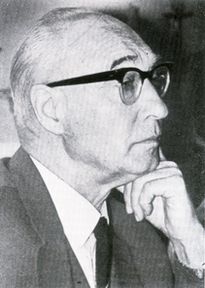
Czesław Jacek Centkiewicz was born in October 18, 1904 in Warsaw.
He was a writer, energy engineer and bank officer.
Centkiewicz's parents were Stanisław and Stanisława née Brosdeczor. His father was an engineer by education. His mother ran the household. During World War I, the entire family was evacuated to Kyiv. In 1916, they were moved to Tver, where his father worked on the construction of the Trans-Siberian Railway. In 1918, they returned to Warsaw.
His parents took care to provide their children with a proper education: the eldest Stanisław, the younger Czesław, and the youngest Halina. Thanks to his father's extensive library, Czesław could develop his childhood and teenage passions. These included: technology, scouting activities, reading books, and sports. In 1914 he joined to the 3rd Kiev Scout Team named after Romuald Traugutt, and after returning to Poland in 1918, he joined the 20th Warsaw Scout Troop. He was, among other things, the commander of a scout camp. At the age of 18, he obtained a driver's license. He then organized courses for rescuers and car drivers. In 1921, he joined the scout sports club "Varsowia." He actively trained in skiing and athletics, particularly long-distance running. In 1925, he won the Polish championship in cross-country running. In 1924, he graduated from the Kazimierz Kulwieć High School in Warsaw. He then pursued higher education abroad. From 1926 to 1928 in Grenoble, France, and then (1928-1929) in Liège, Belgium, where he completed the electrical department of the local Polytechnic (Institut Supérieur Technique de Liège), receiving a degree in electrical engineering with good results. He then underwent internship at, among others, the French hydroelectric power plants in Drac-Romanye (Alps) and Ludyan (Pyrenees).
In years 1930 – 1931 he worked at the Polish Radio Engineering Works in Warsaw, designing and manufacturing low – current devices, including components of alarm system for the Bank of Poland in Warsaw. Then (1931-1932) he worked at the State Meteorological Institute in Warsaw [Le-gionowo] as well as at observatories in Jabłonna, Gdynia, and Hel, and at the Danish Institute of Geomagnetism in Copenhagen. In July 1932, he went to Bear Island as the leader of the First Polish Polar Expedition. For 13 months he conducted research there on atmospheric and electrical dis-charges, the aurora borealis, Earth's magnetism, and a number of other phenomena. After returning in September 1934, he worked on the expedition's results, which were published in 1935. In 1934, he worked for 6 months at the Department of Theoretical Physics at the University of War-saw under Prof. Czesław Białobrzeski. In 1935, he became the head of the Radio-Meteorological Department of the State Meteorological Institute. He conducted research there on atmospheric elec-tricity and designed and built several electrical devices for observatories, including those on Kasprowy Wierch and in Hel. In the years 1937–1939 he worked at the State Tele-Radiotechnical Works on a geniometric device. In 1937 he presented at the International Exhibition of Technology and Art in Paris a radio-geniometric apparatus, designed and built by himself, intended for sounding the upper layers of the atmosphere, which was awarded a gold medal. In 1939 Czesław married Alina Giliczyńska, who later became the co-author of many of his books.
In 1934 he made his literary debut with the book “Czeluskin” and with the memoir “Wyspa Mgieł i Wichrów” (Island of Mists and Winds), in which he described 400 days spent at the North Pole. The Far North fascinated him and became the inspiration and main theme of his literary work. Altogether, between 1933 and 1939 he published seven books on Polish and Soviet polar expeditions. These were, in order of publication: Czeluskin (1934 and 1937); Wyspa mgieł i wichrów (1934 and 1937); W krainie zorzy polarnej (In the Land of the Northern Lights, 1936); Znowu na północy (Again in the North, 1937); Anaruk, chłopiec z Grenlandii (Anaruk, a Boy from Greenland, 1937, 1942, 1943 and 1944); Biała foka (The White Seal, 1938) and Loty nad śniegami (Flights Over the Snow, 1938).
During the German occupation he worked at the State Mutual Insurance Company. After the Warsaw Uprising he was deported to Germany and imprisoned in the Neuengamme concentration camp near Hamburg, and later sent to forced labor in Berlin. At the end of April 1945 he returned to Poland.
On 1 June 1945 he received a nomination from the Minister of Industry to become Technical Director of the Lower Silesian District Power Association and arrived in Jelenia Góra, where he settled, living in a villa at 4 Aleksander Fredro Street. In 1946 his wife Alina also settled there after returning from German captivity.
Czesław Centkiewicz worked in the Jelenia Góra power industry until 1 June 1949. He co-organized the local branch of the Association of Polish Power Engineers (active since 3 August 1946). He took an active part in the lecture and training program organized by the Association. His next workplace in Jelenia Góra was the local branch of the National Bank of Poland, where from 9 November 1949 to 15 October 1950 he served as a controller in the Credit Department. The break in employment from June to November 1949 was necessary for him to complete work on three books.
Throughout their stay in Jelenia Góra, the Centkiewiczs actively participated in the social, cultural, and also political life of the region. In October 1946 he became a member of the Polish Socialist Party, and in December 1948, along with it, he joined the Polish United Workers’ Party. However, he was more active in other fields.
He was most strongly connected with the local literary community. At the end of December 1945, together with others, he founded the Literary Club in Jelenia Góra. At the beginning of 1946 he co-organized the Lower Silesian Branch of the Polish Writers’ Trade Union. At the General Assembly of this Branch, Centkiewicz was elected treasurer, and later (in 1947) secretary. He also took part in the First Congress of Writers of the Sudetes Lands, held in Jelenia Góra from 8 to 11 May 1947. When the National Board of the Writers’ Union, under pressure from the Wrocław community, dissolved the Jelenia Góra Branch on 14 April 1947, Centkiewicz strongly protested, and the Board was forced to reverse its decision on 7 October 1947.
Between 1945 and 1950, during his stay in Jelenia Góra, Czesław Centkiewicz published several new editions of his earlier works and several new books, namely: “Czeluskin”, 1948 (3rd ed.), 1949 (4th ed.); “Wyspa mgieł i wichrów”, 1947 (3rd ed.), 1949 (4th ed.); “Anaruk, chłopiec z Grenlandii”, 1946 (5th ed.), 1948 (6th ed.), 1950 (7th ed.); Biała foka, 1947 (2nd ed.), 1948 (3rd ed.), 1950 (6th ed.); “Wśród lodów północy” (“Among the Northern Ice”, 1948, 1st ed.); “Odarpi, syn Egigwy”, 1949 (1st ed.), 1950 (2nd ed.); and “Zdobywcy bieguna północnego” (“Conquerors of the North Pole”, 1950, 1st ed.). He also worked during this time on other books which were published after he left Jelenia Góra. But it was here that his wife Alina made her literary debut, co-authoring with Czesław the novel “Odarpi, syn Egigwy”, considered one of the “most beautiful stories inspiring the desire for discovery in young Poles.” The book appeared in 1949, though its first fragments were published in 1947 in the Jelenia Góra monthly Śląsk, where the October issue featured their story “Odarpi zabija morsa” (Odarpi Kills a Walrus). Besides literary works, while living in Jelenia Góra Centkiewicz also published informational and technical booklets on electricity: “Elektryczność a pożary” (“Electricity and Fires”, 1949) and “Instalacje piorunochronowe w budownictwie wiejskim” (“Lightning Rod Installations in Rural Construction”, 1950).
In Jelenia Góra and its surroundings, the couple carried out an extensive lecture program. Centkiewicz was especially active in these initiatives, and the local press often reported on his talks, for example: “On 23 May in the hall of the Lower Silesian District Power Association in Jelenia Góra, an interesting lecture by Comrade Engineer Centkiewicz entitled ‘The Arctic’ was held. The speaker spoke about polar expeditions, the participation of various countries in them, particularly the scientists of the Soviet Union. He also devoted much attention to Papanin’s expedition, which reached the North Pole. The lecture aroused great interest among the audience, who asked Comrade Centkiewicz for more frequent presentations” (Słowo Polskie, 1.06.1950). Centkiewicz’s lectures attracted large audiences because they concerned distant and little-known regions, were delivered in a highly expressive manner, and were enriched with slides—a rarity at the time.
Czesław Centkiewicz also actively participated in the cultural and social life of Jelenia Góra. He was active in the Polish YMCA, serving on the Board of the local branch of the organization. Through the Writers’ Union, he was delegated to the Municipal National Council of Jelenia Góra, serving as a council member from 5 September 1949 to 26 May 1950. He also participated in campaigns against illiteracy and many other initiatives.
In 1950 the Centkiewiczs returned to Warsaw and settled in Saska Kępa, on Zakopiańska Street. Czesław resumed work at the PJHM Institute of Areology. In 1955 the Presidium of the Polish Academy of Sciences appointed him to the Polish Committee for the International Geophysical Year. In 1958 he travelled to Antarctica to take over and adapt for Poland the Soviet scientific station “Oazis.” After this expedition he ended his professional career and devoted himself entirely to literary work. Nevertheless, between 1950 and 1980 he undertook about 80 journeys. He wrote over 30 books, which were translated into several languages. Many of them are still reprinted today and remain popular among readers. Several scouting troops and a number of primary schools in Poland, including in Wałbrzych, were named after him.
Czesław Centkiewicz died in Warsaw on 10 July 1996. His body was cremated and on 27 September 1996 laid to rest in the Avenue of the Meritorious at Powązki Cemetery in Warsaw, beside his wife Alina, who died on 11 March 1993.
For a closer look at the life of Czesław Centkiewicz and his wife Alina, see the booklet by Antoni Olcha Centkiewiczowie (Warsaw 1973, 35 pp.), as well as two posthumous memorial articles: Ewa Nowacka, Czesław Centkiewicz (18.10.1904–10.07.1996), “Guliwer”, 1996, no. 5, pp. 49–50; and Maciej Zalewski, Czesław Jacek Centkiewicz (1904–1996), “Przegląd Geofizyczny”, vol. 42, 1997, issue 1, pp. 80–85. Information about the Centkiewiczs’ stay in Jelenia Góra can be found in two studies: Ivo Łaborewicz, Czesława Centkiewicza życiorys spisany w Jeleniej Górze (1950), “Skarbiec Ducha Gór”, 2004, no. 4(32), pp. 4–5; and Ivo Łaborewicz, Centkiewiczowie w Jeleniej Górze (1945–1950), “Karkonosze”, no. 5/2005 (235), pp. 7–10.
Photo from: Centkiewicz, Cz. Wyspy mgieł i wichrów. Warsaw, 1969.